
Published 18 Aug 2026
Christ in the Abyss: An Excerpt
from the introduction by Jean Lee Neely
A blog post Women Scholars and Professionals

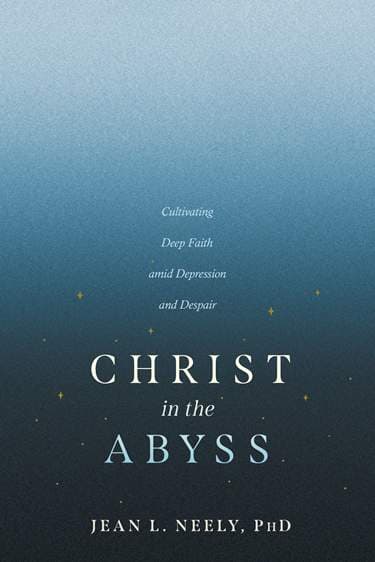
Dip into this excerpt (the Introduction) from Jean Neely’s recent book Christ in the Abyss: Cultivating Deep Faith amid Depression and Despair— a perfect companion piece to our conversation on the Women Scholars and Professionals podcast.
Introduction
FACING THE ABYSS
The grace of God means something like: “Here is your life. You might never have been, but you are, because the party wouldn’t have been complete without you. Here is the world. Beautiful and terrible things will happen. Don’t be afraid. I am with you.”
Frederick Buechner , Beyond Words
Such beautiful and terrible things. The beautiful parts deepen when shared, and the terrible things seem to shrink back in thecompany of friends. So it’s tragic that we’re not more open about the most harrowing things we face. Many of us never come to realize that we really do belong at the party.
Some of my most terrible things have been tied to living with chronic mental pain. When I was fifteen, I began to experience manic episodes and periods of severe depression, and I was diagnosed with what psychiatry currently calls bipolar disorder (bipolar I, to be specific).
For decades, in addition to wrestling with persistent, debilitating depression, which is often more difficult to treat than mania, I was constantly anxious over what my condition meant for my spirituallife. I felt I embodied the opposite of everything a person of faith was supposed to be, and so much around me seemed to confirm that view.
I grew up with no examples of faith accompanied by unfixed inner pain or faith that constantly floundered with doubt. For a long time, I couldn’t find much helpful insight on depression from the church. I didn’t personally know of anyone who followed Christ and had on-going crises in faith or frequent chutes into despair or who was unwell as often as I was. People who stood out as models of Christian faith were those who had overcome their inner troubles, were well on their way to overcoming them, or were good at keeping them hidden.
These days there’s more open conversation around mental health in the church, thanks partly to an emerging abundance of literature with nuanced perspectives on faith and mental suffering. I think of writers such as Monica Coleman, Alia Joy, J. S. Park, and Cole Arthur Riley, just to name a few. We have a more holistic understanding of mental health and the intertwinement of body and spirit.
Despite this growth in the church, however, moving through the abyss of depression and inner pain can still be one of the loneliest experiences for a person of faith. It’s difficult to find company in navigating these depths even though so many of us spend drawn-out seasons here. We long for more company as we face the terrible and incomprehensible parts of our lives that don’t fit neatly into dominant faith narratives.
THE DEPTHS OF FAITH
If I go up to the heavens, you are there; if I make my bed in the depths, you are there.
Psalm 139:8, NIV
Our faith communities often focus on life above the soul’s sea level, as it were. We’re reluctant to address the deeper, dimmer realities— the ocean of shadowy unknowing in faith or the abyss inside each of us. But some of us go through long seasons where we feel stuck in anguish or lost “in the depths” (Psalm 139:8, niv) and “the remotest part of the sea” (verse 9).
When I’m depressed, I dwell in the abyss, at the bottom of the ocean floor, far from the land of the living. I’ve wondered how to trust that “even there” (Psalm 139:10) God is with us. And why don’t we talk more about how the life of faith can run through these chasmic depths?
There are so many existential aches we don’t explore openly in the church— the unanswerable questions, apparent absurdities, and our utter groundlessness. Though the church focuses on the sunnier sides of faith, the reality is that sometimes our paths linger along deep ocean trenches. That’s where I live. Even when I’m not depressed, I feel I’m swimming in heavy, unnavigable waters. There are unseen dangers all around, and I’m full of restlessness, an abyssal longing.
Strangely, I feel God has met me in this bottomless deep. But it’s not the sort of thing that’s easy to describe or bring up with just anyone. People prefer tidy concepts and solid ground over irresolvable mysteries and the yawning void.
In our triumphalist faith cultures, it’s easy for those of us with persistently unresolved suffering and inner shadows to feel ignored by God or overlooked in our communities. Without more open conversations about inner anguish and the cruelly felt absence ofGod, our sometimes unavoidable pains can turn into unnecessarily magnified spiritual torment.
We need faith spaces expansive enough to welcome the tensions we feel between our afflicted minds and our devotion to Christ, spaces where people are less presumptuous about trying to fix us and where they’re not scandalized by the coexistence of our hope in God and our easily faltering faith. I think often of the importance of “narrative plenitude,” a phrase coined by award- winning novelist and literary scholar Viet Thanh Nguyen.1 Nguyen uses the term to describe our need for a creative imaginary that is richer with the singularity of stories and voices beyond our familiar, dominant forms of representation. The church is in desperate need of such plenitude, stories that tap into the diverse and unfathomably deep contours of real life. We suffer from “narrative scarcity,” an erasure of so many different winding paths, unnamed ways, and unique embodiments of faith in Christ.
The diversity of our stories should include neurodiversity, emotional and cognitive diversity, and diversity of temperaments and spiritual leanings. Because our most common narratives about “great faith” are so limited in scope, and because those who wield these narratives have such amplified influence in the church, it’s easy to believe that something is seriously wrong if none of the common narratives resonate with our own. It can be difficult to imagine the possibility of faith outside the recognizable molds or the reality of a Love greater than all the known stories.
This book is my small attempt to add to a growing narrative plenitude in our faith communities. It’s not an authoritative guide on faith and mental health. There are no quick fixes for mental or spiritual distress. To be clear, I have no schooling in psychology and no formal theological training. I’m simply offering stories from my own path with Christ and the personal challenges I’ve faced with depression and faith over the years.
THE MYSTERY OF GRACE
Depression is still a regular part of my life, but somehow, the abyss of excruciating inner pain and desolation of my teens, twenties, and early thirties has morphed ever so slowly into a different kind of abyss, one with a little more peace in Christ. I attribute it all to grace. When I say all is grace, I don’t mean that God is any less gracious to those who have no relief from depression or are caught in other horrific conditions. I don’t know how grace works, but I don’t believe God is withholding grace from people caught in unrelenting pain. It’s all steeped in mystery.
We live in an imperfect world. Yet beauty and grace abound.
In the chapters ahead, I discuss grace- filled moments that helped with various liberating shifts in my personal perspectives over time. However, I don’t think that mental health is a strictly individual endeavor or that merely adjusting our beliefs will heal complex conditions. Our pain might be rooted in our physiology and also shaped by historic wounds, our environments, and unjust systems. How we navigate our inner world does matter, but things don’t depend solely on us. There’s certainly work to do in changing the contexts that make us unwell.
The struggle is broad and multifaceted. We’re multidimensional beings with multidimensional aches and pains. Labels like bipolar disorder are clumsy categories for broad spectrums of conditions and different ways of being. Yet even rough, provisional terms can open paths to relief, and psychotropic medication can be lifesaving for some of us. I consider it a grace that I was diagnosed early and have had access to care that I’ve needed. I believe it’s in part because I’m currently on medication that I’m able to write this book, and based on experience, I expect to need mood- stabilizing medication for the rest of my life.
While some of us might benefit from clinical treatment for mental health, that’s not always what’s needed, and even when it’s helpful, it’s not sufficient for our growth toward wholeness. It addresses just part of what ails us. We all need and long for so much more. We need each other. We need the wisdom of our elders and their ancient paths, assurance of the love that holds us, and the Spirit’s gentle touch.
In this book, I share about how I’ve wrestled with faith in the abyss of depression and mental pain. I address certain beliefs that made my experiences of depression feel worse for many years, and I explore encounters that helped dislodge stubborn fears of God’s rejection.
As much for my forgetful, depressed self as for other readers, I write to call attention to the merciful reality that even if we make our bed in the depths of the deepest sea, God is there.
The more we share about our sojourns in the shadowy realms of faith, the easier it becomes to hear the loving voice of the One who stays with us through the shadows, however long the night, however deep our abyss. My hope is that as we share our experiences of life in the deep we would find some shelter in each other’s company and encounter more of the mystery and grace of Christ always with us in the abyss.
Excerpted from Christ in the Abyss by Jean Lee Neely. Copyright © 2026 by Jean Neely. All rights reserved. No part of this excerpt may be reproduced or reprinted without permission in writing from the publisher.

Dr. Jean Lee Neely is a Korean American writer and a writing instructor at Azusa Pacific University. She writes regularly on issues of mental health and faith for Faith & Leadership, a resource from the Duke Divinity School for Christian leaders. She has also written for Sojourners, Inheritance Magazine, the Asian American Christian Collaborative, and Christians for Social Action. Jean and her family live in California.