Hello Chelsea. It's so good to talk with you! I'm curious about what moved you originally to study languages and education. What was your leading there?
Well, my grandmother was in a school and she worked in a school cafeteria. You know, when she was born in the early 1900s, there weren't many options for women of color. My mother, pre-World War II, wanted to go into education. But, she said she always felt more the pressure to be a wife and to be a mother. She did though eventually become the first ESL [English as a second language] assistant teacher in the township where we grew up in a suburb of Philadelphia.
Were your grandparents in Philadelphia as well?
My grandma was born in Virginia. Her grandparents, because they were biracial, lived in Canada, the only place they could live at the time. Eventually they moved down to Virginia. She met my grandfather in New York and he was from North Carolina. He was involved with Reverend Sullivan and Martin Luther King and the Civil Rights movement. The story goes that he was with a group that was about to be blackballed, at the time, so he actually changed his last name. So, we have a different last name than what he was born with. [Laughing]
That sounds like quite a story!
I have a family member who is meticulously taking notes, even back to my great-great-grandfather. My grandparents eventually came to Philadelphia, and then every ten years had two children. [Laughing] The forties, the fifties, and sixties, they raised two children each decade. For all of them, education was very important. Our mother worked for a school, while my father went to college. He went into business and then also taught business as an adjunct professor., He later owned his own insurance company. So there are the things that, while no one sat down and talked with me and said, "This is what you need to do," I was able to watch how to do what they do.
And you studied Spanish. Where did that come from?
There's no Hispanic background in my family whatsoever. But our mother, working with ESL, always worked with a diversity of people. And we've always had a diversity of friends around. But when I was in high school, my Spanish teacher nominated me as one of three, out of about four hundred students, for a summer foreign language program through Temple University. I was not by any means the brightest student in the class. I was not the most forward student in the class. I was very surprised to be chosen.
But my family always encouraged us to be willing to try new things. I entered the program and actually took Japanese. So for three summers in high school, I studied Japanese.
My teachers, too, encouraged me and pushed me into places that I would not have gone or chosen myself. As a senior, my guidance counselor asked me to be a Spanish tutor for a freshman. I just said, "Well, I'm not even the best Spanish student in the class!" [Laughing] She said, "No, but we thought that you might have a good way with the students to help them to understand." And I felt like, okay, I am in a class with all these kids who are headed to Ivy League schools, and here's me going to a state school, but I’m willing to try. I enjoyed that experience. I watched that student go from failing to really getting her head above water. She started being able to do well in class and that really motivated me.
But when I went to college, I still went undecided. I really came into Spanish because I needed a job. [Laughing] My parents had separated, and we were left to our own devices to take care of ourselves. So I went into town to get a job working at a daycare center. They hired me but they thought I was older. They thought that I was a junior or a senior, and I'd only been in college a week. The director asked, "What's your major?" and I said, "My major? Well, I love education." She said, "Well, I figured that." And I said, "Yes. Yes, Spanish and education." Why did I say that? I didn’t even speak Spanish! So that afternoon, I went over and pleaded with the dean so that I could get the paperwork signed off to become a Spanish major. [Laughing] I said, I need it because these people at this job think I'm studying education and Spanish!
I stuck with it. I struggled with it. I saved up enough money to go to Costa Rica by my sophomore year. And the end of my sophomore year, my father passed. He had paid my tuition the first year, so I didn't know what to do. And the money I had saved up my mom needed for the funeral money, so she took the three thousand dollars that I had saved up for Costa Rica, and put it towards my dad's funeral.
But a month or so later, the international coordinator said, “Y'know, we have a National Student Exchange (NSE) program with Puerto Rico. I've heard you were really heartbroken about not being able to go to Costa Rica, but how would this work out?” And I said to myself, "Well, let's go to Puerto Rico. This is my opportunity.” So I filled out the paperwork and got my acceptance within a month. Two months later, I had my plane ticket. The program ended up being the same tuition as my college and because the room and board was cheaper, I actually got money back.
So, that's how I came into being a Spanish teacher. I went and lived in Puerto Rico and I came back speaking Spanish.
Wow! The Lord leads in mysterious ways.
Yes! My life is a series of, “as the Lord leads.” Some doors open and other doors close. And believe me, when they close, they close hard. But I'm grateful for the doors that have opened.
That's pretty sweet. And you walk through them.
I walk through them. And then sometimes, you know, I kind of shudder. I stop and go, "Wait a minute. What did I get myself into, and where am I going?" But that's a part of the trust walk. And, you know, it has not failed us yet. My two sisters and I finished college, each own our homes, we've moved forward in life. And it hasn't been because of the things that our parents have given us financially or materially. But I truly believe it's the things that they have left us, in the contexts of values, ethics, integrity, just being able to go back into faith, and the Word, and being trusting.
Is your mother still living?
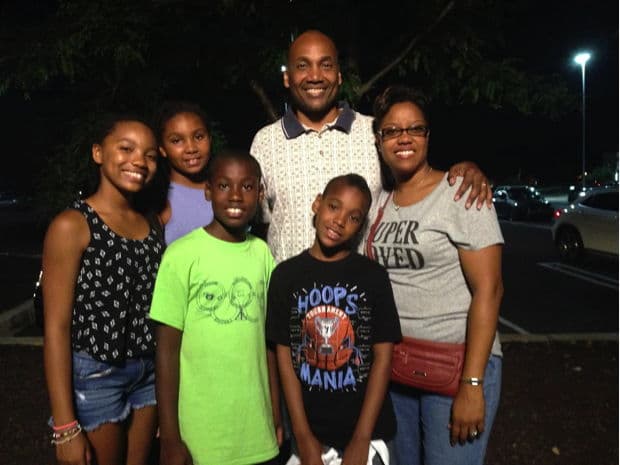
My mother passed and that was another journey in my life. I was a Spanish, History, and ESL teacher for a while, up until 2005. My husband and I had four children in five years and my mother had been helping me with the kids. But in 2006, while expecting my fourth child, I resigned from teaching, not knowing that six months later, my mom would have her first stroke.
She had been helping to take care of your kids?
Yes. And five months after that, she had a full-out stroke where she was incapacitated to the point of not even being able to feed herself. She had to use a feeding tube. They gave her a month to live and basically put her on hospice. And they looked at me like, there's no way you can take care of her. Look at what you have already. But my mother and, my grandmother, always took on whatever came. My mother took care of my grandfather. She took care of her sister. And my grandmother had taken care of everybody, with almost nothing, in a little home, three bedrooms — one didn't even have a closet. [Laughing] But she fed everyone. She clothed everyone. And so, knowing how much more we had, taking my mother in I felt was the very least I could do.
So you had four little children at the time?
By the time she had the second stroke, they were nine months, one, two, and almost four. But she moved in with us. I was able to get her off the feeding tubes. She lived for three more years. We did what we could to keep her involved and engaged in life.
I hear no regrets from you.
No, my kids knew and loved her.