
Published 24 Jul 2013
Women in Leadership: An Interview with Nikki Toyama-Szeto
Nikki Toyama-Szeto chats with us about her development as a leader, racial and gender dynamics, and the appropriate use of power.
By Nikki Toyama-SzetoA blog post Women Scholars and Professionals
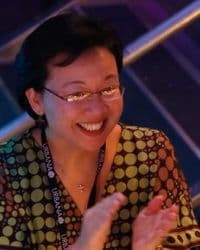
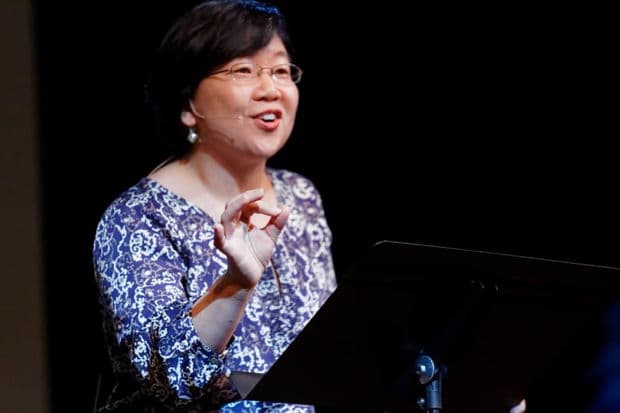
Photo: Matt Kirk
That’s right. Because I realized the only reason I would stay would be to get money. And to do something only to get money is also called idolatry, because I would have believed more in the power of that cash to take care of me than in the power of God.
But it was a jump. I wasn’t sure it was right. It was a bit of a . . . This might be a mistake, but I’d rather err on the side of trusting God too much.
There was a need at University of San Francisco and I had interests in what was going on at UC Berkeley. The InterVarsity chapters there were grappling with issues of justice and racial reconciliation, two areas I wanted to learn about.
During my time with InterVarsity I went through a program called the Daniel Project, an executive leadership training program. At that point it was only designed for Asian American leaders. The director, Paul Tokunaga, had seen how many Asian American students and faculty InterVarsity worked with, but did not see many Asian American staff in the leadership pipeline. He was looking for a systemic way to address that gap, and so chose thirteen or fourteen folks to give accelerated leadership training to. It was really fantastic.
I had, at that point, a strong sense of leadership and I think was given a decent amount of scope for it as well. But I don’t think I had the language to know which things were culturally-bound and which things were gender-bound. And so you would get this young and just-starting-to-form leader who’s articulating poorly, or alienating people as they’re trying to articulate the things that, to me, felt like universal wrongs. I don’t know if I knew to name it as a gender dynamic or as a racial dynamic.
Coming out of the Daniel Project, we did a women’s consultation, a Biblical consultation where all of the women in the Daniel Project (I think there were nine of us) all Asian Americans, went away for a weekend and shared stories of our leadership journey. And that ended up turning into a book called More Than Serving Tea.
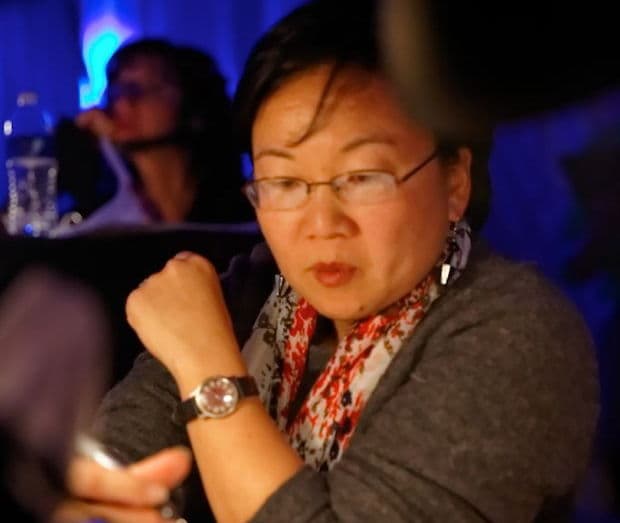
Photo: Matt Kirk
If you look at Jim Collins’ organizational leadership theory in Good to Great, he talks about a level five leader. The common conception of a leader is articulate, charismatic — you know, the Steve Jobs of the world. These are the folks you think of as leaders — visionary, creative, kind of lone wolf types. But if you actually look at organizations that go from good to being great, those level five leaders have very different characteristics, like being collaborative, being more modest, or humble —characteristics that actually match up with many of those that might be found in Asian American leaders.
For example, taking initiative in a white context looks very different than taking initiative in an Asian American context. So, for example, taking initiative in most of my classroom settings or work settings meant raising your hand, volunteering, saying I can do that, or I would like to do that. That’s a white male kind of a version, right? “I can do that.”
This is so different than taking initiative in an Asian American women context. Here taking initiative looks like — and you’ll see this all the time — we’re about to start a meeting, and somebody’s missing. The Asian American woman, she won’t say anything but will go out and get that person to tell them, “The meeting is started.” Or we’re about to leave for lunch and the Asian American woman will say, “Oh, wait, so-and-so went to the bathroom. We should wait.” So I think that there’s a way that they’re taking initiative, but I would say that sometimes the form in which it’s expressed is actually more helpful to the group than for them individually. In some ways, it’s an “I’m silent” leadership characteristic, but keeping everyone at the table..
The Daniel Project was really key for me, and I think it was helpful for the organization when they began to realize that our views of leadership are culturally-bound. For the organization, they began to understand that we’re promoting people who are like us, but maybe there are people who have leadership skills that look different than ours but have some of the same values that we’re looking for. I remember talking to a good friend of mine who was at business school in Stanford, and not a woman of a faith background. I told her at the time about the Daniel Project, and she was so amazed. It echoed the things she was experiencing in her graduate business school education, and some of the challenges and the dynamics for women and women of color in academia and in business at that level. I think it was a way that InterVarsity is a great witness for folks in this field because of how we’re thinking about these issues of leadership in terms of gender and ethnicity.
One of the things that the Daniel Project challenged us to do was to dream and to make plans for our future. I think as women leaders, there’s not a lot of permission for either of those things. To dream is to do one thing, and sometimes that can feel really hard. I found for me as a woman, it was really hard just to sit and dream just for myself. I feel like I needed permission and encouragement over and over and over to do this, that it was an okay, not a selfish thing to do. And then to actually make a plan.
My mentor in the Daniel Project, Andrea, an amazing person, invited me to work with her in advancement. It was wonderful to work with her and observe how she used power. She had power but she stewarded her power. She knew what power she had. She knew what I had and what I didn’t have. So if I was starting on a project, she would always use her power to extend the reach of my power. And so I felt like there was a way that she was aware of power, and used it in a way that, to me, felt empowering. I felt blessed by the power she had.
Yes. Rather than controlled, limited, or stonewalled because of it. I think it is folks with power who don’t think they have power who are some of the most dangerous folks. Dangerous because they don’t realize when they swing, how far their impact is, the effect of the things that they do.
I don’t want to be that person that has power but pretends that they don’t.

Photo: Matt Kirk
For one thing, I think it is really important for women to embody their leadership. Because so many of our leadership models are male-based, women don’t necessarily embody it in their own selves. They try to dress differently. They try to, in a sense, operate cross-culturally, the culture being cross-gender, in order to be effective. And I think sometimes that is appropriate, but I really appreciate work such as MaryKate Morse’s work on women and embodied leadership, knowing the space you take up, knowing the impact your space has on other people. I think that’s all part of power, understanding and knowing within your own self what is the power that you have, and also the source of that power. Some of it is God-given authority, some of it is positional authority, some of it is authority that we’re given because of our education, our economics, our fluency in English, etc.
And then, I think, trying to grapple with how you steward it. I have come to understand that leadership is more about other people’s experience of my presence, and the impact that my presence has even when I’m not there. I think a good litmus test for someone who is using power well, as reported in Lean In, is when you’re gone, do people feel less oppressed, a greater sense of freedom, or — the language I like to use is — does my presence bless people? Or is my presence a hardship?
There are also cycles of power we need to recognize. It’s very interesting to look through a Christian lens — there’s having power, there’s giving up power, and then there’s claiming power. Some of it depends on where you are in that circle, what the faithful response to power is. So in some cases, if you have power, the faithful response is actually to relinquish power or to use your power for somebody else. And then in other cases, when you’re disempowered, the faithful response is actually to step and to claim power. For example, trying to step into Shalom. Our world is broken and you might actually need to step in and say, this isn’t right. It is important for women in power to understand what of the power they have is theirs to give away, where do they need to take that power and step in and claim more-- possibly for their own self or for a greater thing such as the health of their organization — and where do they just need to steward the power that they have.
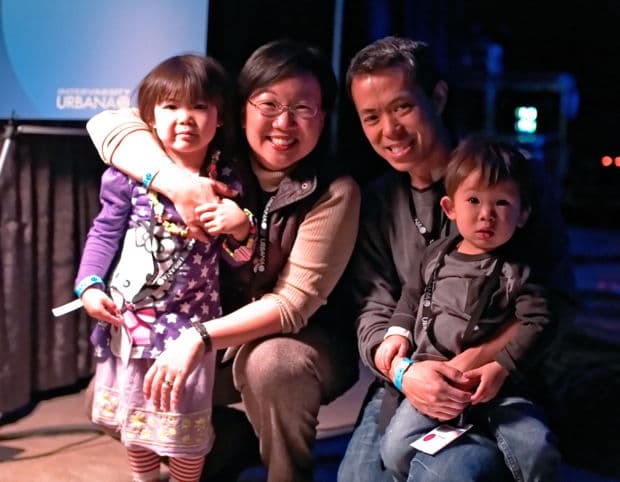
Photo: Ken Fong
Oh, yes. It’s smooth sailing. [Laughter] We developed a plan when my daughter was born, and we stuck to it. [More laughter] My spiritual director says your plans will work for a few months, and then you might have to adjust or change them. That was really helpful to know. It’s not useless to make plans, but know that the needs of your child, or your needs, or your marriage’s needs, are going to change. It was helpful for me to know we weren’t failing when we had to change our plans every few months.
We have two kids, two-and-a-half and four-and-a-half. Really cute, really fun. We co-parent, but I don’t think we ever, said, “Oh, there’s this philosophy. Let’s co-parent.” But I think that’s the best way to describe it. So my husband is very engaged and I’m very engaged with the raising of our kids.
My job has required quite a bit of traveling, so we had to navigate some of that. In their first year of life, I took each of my kids with me on every single trip. So if I couldn’t bring them along, I didn’t go. And I think some of that was a little bit my mischievous side. For example, I was involved in planning for the Lausanne Gathering 2010 in South Africa. I was part of some of those conversations, and the leadership said, “We want women. We want young people.” So I showed up with my baby in my baby carrier to the leadership meetings and people just did not know what to do with me. And I’m thinking, if you want women, and you want younger women, sometimes it looks like this. It’s like, what’s your childcare arrangement on-site? I felt like I always had to do two to three times the logistical work just to show up. But I did it. It was the thing I needed to do to feel good about my two calls, my calling as a mother and my calling to this particular ministry at that time.
Yeah. I read every book I could; not helpful. Mommy Wars, Stay-At-Home Mom, Working Mothers, and then you add the Christian level to that. Not helpful.
Women do ask me certain kinds of questions that I appreciate. Some of the questions they asked as I was considering this new job were, what’s good for your marriage? What is good for your family? The Urbana timeline is pretty intense. It ebbs and flows, which is what makes it work, but considering what was good for our whole family was part of what tipped the decision to take the IJM job.
I think the world and the church need more women leaders. I think it’s for the good of everyone involved. It’s not something where more women leaders means fewer men leaders. I think more women leaders means better men leaders. So, yes, I’m excited about the ministry of The Well and the way The Well continues to push forward this conversation. So I’d just say I’m excited to see women leaders continue to expand the conversation.
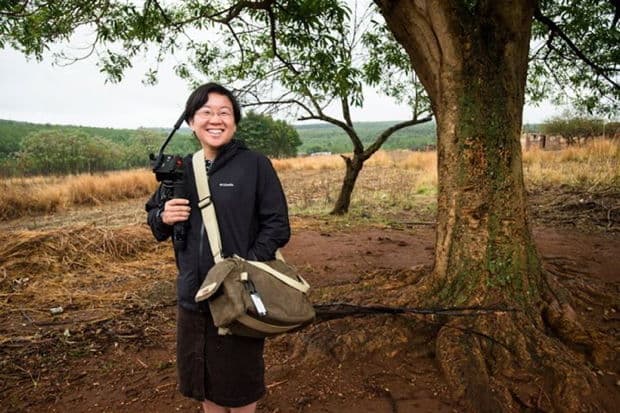
Photo: Matt Kirk
Tags:

Nikki Toyama-Szeto serves as Program Director for InterVarsity’s triennial missions conference, Urbana. Before joining InterVarsity, she worked as an engineer in Silicon Valley. While on staff, Nikki served at Stanford, U of San Francisco, and UC Berkeley and helped develop and direct the Global Urban Trek, an urban immersion program designed to challenge students to use their majors on behalf of the world’s poor people. She is co-editor of the book More than Serving Tea, a collection of essays, stories, and poems looking at the intersection of race, gender, and faith for Asian American women. Nikki resides in Madison, Wisconsin, with her family.