
Published 25 Nov 2025
Advent Week 1: Hope
by Karen Hice Guzmán
A blog post Women Scholars and Professionals
Women Scholars and Professionals invites you into the practice of Visio Divina as an Advent meditation — something to support the work of rest, restoration, and preparation that we hope is part of the season’s different rhythms. Welcome to our Advent 2025 Visio Divina Series.
Visio divina — divine seeing — is an ancient prayer practice inviting us to use our eyes to lead us in contemplation about God and enter into prayer with him. Each week, we’ll share a piece of art and invite you to look at it and consider it with a set of four basic questions.
What do you see?
What stands out to you?
Is there Scripture that comes to mind?
What is God’s invitation to you?
In addition, we’ll provide a bit of Scripture to consider, a short reflection, and a prayer.
We’ve selected pieces from a variety of artists, art periods, and styles. Not all of them are “Christian” in content, nor are they all from artists who would identify as Christian. We do, however, think that each piece of art has something to say to us about God, about ourselves, or about what it means to be his people.
We’ll use this practice with a piece of art, but it can easily be adapted to use whenever you observe something of beauty, whether on a trip to the art museum, a day at the beach, or a hike in the Grand Canyon.
Visio divina invites us to engage with God using our minds, our imaginations, and our hearts. Many of us “live in our heads,” so it can be helpful to be led into exercises which engage all of who we are. Whether this practice is new to you or very familiar, our prayer is that it will be life-giving. Are you ready to get started?
Week 1: Below the Surface

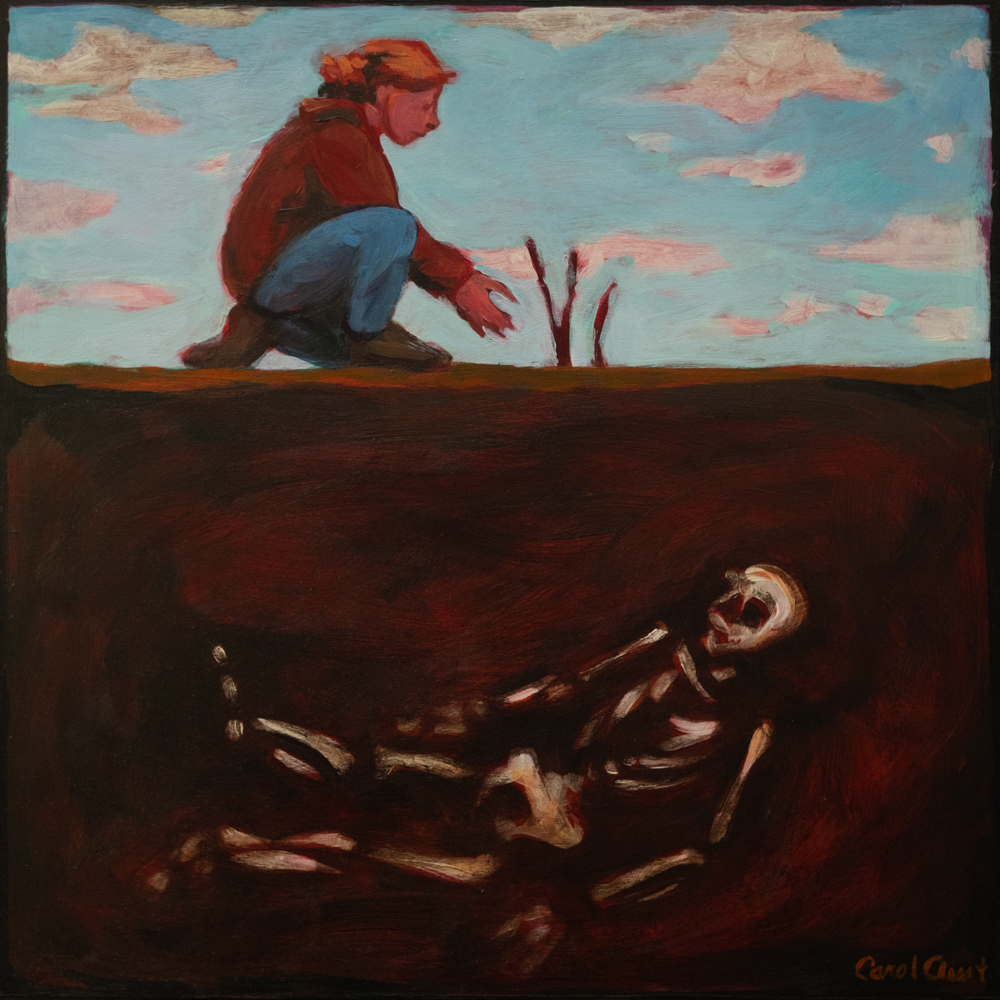
“Below the Surface“ by Carol Aust
To learn about Carol Aust and her work, please visit her website. Carol graciously gave us permission to use Below the Surface for this Advent visio divina series.
Questions for visio divina
As you begin, take a few deep breaths. While we know God is always with us, invite the Holy Spirit to be present and to speak to you afresh in these moments. Spend some time looking at the image. What do you see? Similar to doing Bible study, make as many observations as you can. What do you like or dislike? Why? What questions do you have?
How does the artist use color, light, style, composition, and material? What do you think the artist wanted to communicate? What stands out to you? Why do you think this is so?
Read Psalm 130 (below). How does this add to what you are seeing? Is there other Scripture that comes to mind?
Spend some time reflecting on the Scripture passage and looking again at today’s image. What is God’s invitation to you? What might you need to see, understand, or believe? How does your current life experience intersect with what you are seeing and reflecting on? How might this image help you pray today? What do you want to say to God? Ask from him?
Scripture passage
Psalm 130
A song of ascents.
1 Out of the depths I cry to you, Lord;2 Lord, hear my voice.Let your ears be attentiveto my cry for mercy.
3 If you, Lord, kept a record of sins,Lord, who could stand?4 But with you there is forgiveness,so that we can, with reverence, serve you.
5 I wait for the Lord, my whole being waits,and in his word I put my hope.6 I wait for the Lordmore than watchmen wait for the morning,more than watchmen wait for the morning.
7 Israel, put your hope in the Lord,for with the Lord is unfailing loveand with him is full redemption.8 He himself will redeem Israelfrom all their sins.
Reflection
Advent’s most basic meaning is “coming” or “arrival.” Throughout the season we are invited to look back and look forward. To remember the longing of God’s people for the arrival of the redeemer God had promised — Israel’s Messiah King who would come and set the world right (see Genesis 3:15, Deuteronomy 18:15-18, Isaiah 9:1-7). And recall that we, too, long for Messiah’s coming (in the words of Hebrews 9) “not to bear sin, but to bring salvation to those who are waiting for him.” We live in that awkward now-but-not-yet space and, because God is trustworthy we, like God’s people of old, wait in hope.
Hope is a theme from beginning to end in Scripture, so it is a fitting theme for the first week of Advent. God’s people wait in hope for him to act on their behalf. In hope, they pray for God’s Kingdom to come and his will to be done on earth as it is in heaven. They look forward in hope to the day when it is declared:
“Look! God’s dwelling place is now among the people, and he will dwell with them. They will be his people, and God himself will be with them and be their God. He will wipe every tear from their eyes. There will be no more death or mourning or crying or pain, for the old order of things has passed away.” (Revelation 21:3-4, NIV)
Hebrews 6:19 reminds us that “we have this hope as an anchor for the soul, firm and secure.”
Planting a seed or seedling is an activity imbued with hope. In the top third of Below the Surface, a figure kneels alongside a recently emerged plant. Visible in her gesture, hope longs for the young plant to flourish almost coaxing it into growth. “C’mon, little guy.”
The other two-thirds of this painting reveals what is “below the surface.” A skeleton. All that remains from a life once lived. We wonder: does this young woman know what lies beneath the ground on which she rests, the ground that holds and nourishes her young plant?
It is a work of contrasts:
new life and growth vs. death and decay
beginning vs. end
visible vs. invisible
dark vs. light
expanse vs. containment
Below the Surface holds these contrasting realities together in one piece — hopeful waiting for a new or coming thing alongside loss and decay. I find it hard to hold these things together in my life, especially when it seems as though two-thirds of life is the hard dark stuff. Romans 5 reminds us that like a decaying body which becomes part of the nutrient rich soil nourishing plant life, if we let them, hard things produce resilience and hope in us. Christian hope is not fingers-crossed coin-tossing in the well, wishing for something we want. It’s the solid assurance of God’s accomplishing what God wants evidenced in the life, death, resurrection, and ascension of Jesus. This kind of hope grounds us and enables us see and hold the beauty of God’s presence and work in the world even as we are fully aware of and hold the grief and darkness of the world and our own situations.
As you enter into this season of Advent, what feels dark or hard or even dead? Where might God be inviting you to live into the hope that is ours in Christ, our coming King?
Israel, put your hope in the LORD,for with the LORD is unfailing loveand with him is full redemption.
Prayer
We are well aware, God, that all is not right with the world. We see brokenness in and around us. Sometimes it is overwhelming and hard to bear. Thank you that you did not leave us alone, but sent your Son as the light of the world. Grant us eyes to see where you are bringing new things to life. Fortify us in hope as we wait for all you have promised. Amen.