
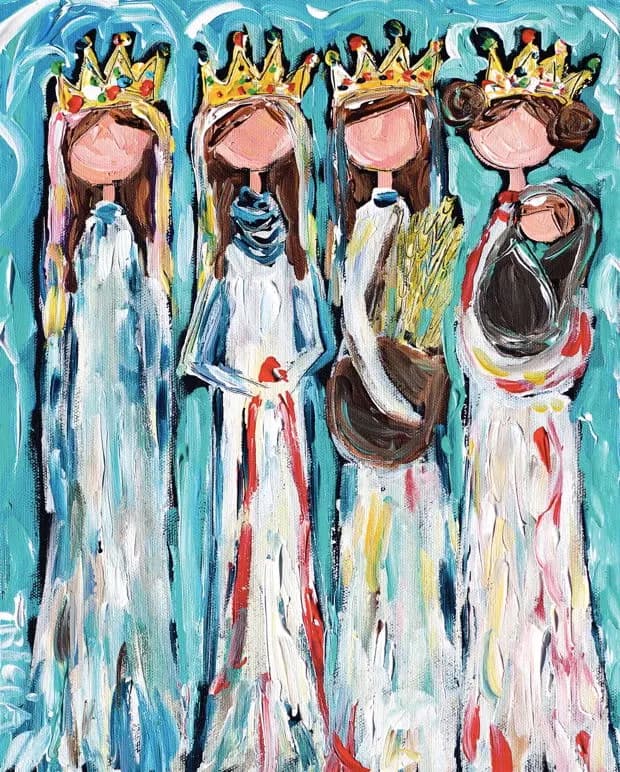
Welcome to our Advent 2025 Visio Divina Series, a visual meditation practice we are using as an entryway into this season. You can read more about this practice in our first installment of this series. This week we move into the 12 Days of Christmas — celebrating God’s coming to us in the person of Jesus. Glory to God in the highest heaven, and on earth peace to those on whom his favor rests!
The Four
The Four by Tricia RobinsonTricia graciously gave us permission to use this image in our Visio Divina series.
Questions for visio divina
As you begin, take a few deep breaths. While we know God is always with us, invite the Holy Spirit to be present and to speak to you afresh in these moments. Spend some time looking at the image. What do you see? Similar to doing Bible study, make as many observations as you can. What do you like or dislike? Why? What questions do you have?
How does the artist use color, light, style, composition, and material? What do you think the artist wanted to communicate? What stands out to you? Why do you think this is so?
Read Matthew 1:1 - 17 (below). How does this add to what you are seeing? Is there other Scripture that comes to mind?
Spend some time reflecting on the Scripture passage and looking again at today’s image. What is God’s invitation to you? What might you need to see, understand, or believe? How does your current life experience intersect with what you are seeing and reflecting on? How might this image help you pray today? What do you want to say to God? Ask from him?
Scripture passage
Matthew 1:1 - 17
1 This is the genealogy of Jesus the Messiah the son of David, the son of Abraham:
2 Abraham was the father of Isaac, Isaac the father of Jacob, Jacob the father of Judah and his brothers,
3 Judah the father of Perez and Zerah, whose mother was Tamar, Perez the father of Hezron, Hezron the father of Ram,
4 Ram the father of Amminadab, Amminadab the father of Nahshon, Nahshon the father of Salmon,
5 Salmon the father of Boaz, whose mother was Rahab, Boaz the father of Obed, whose mother was Ruth, Obed the father of Jesse, 6 and Jesse the father of King David.
David was the father of Solomon, whose mother had been Uriah’s wife, 7 Solomon the father of Rehoboam, Rehoboam the father of Abijah, Abijah the father of Asa,
8 Asa the father of Jehoshaphat, Jehoshaphat the father of Jehoram, Jehoram the father of Uzziah, 9 Uzziah the father of Jotham, Jotham the father of Ahaz,
Ahaz the father of Hezekiah, 10 Hezekiah the father of Manasseh, Manasseh the father of Amon, Amon the father of Josiah, 11 and Josiah the father of Jeconiah and his brothers at the time of the exile to Babylon.
12 After the exile to Babylon:
Jeconiah was the father of Shealtiel, Shealtiel the father of Zerubbabel, 13 Zerubbabel the father of Abihud, Abihud the father of Eliakim, Eliakim the father of Azor,
14 Azor the father of Zadok, Zadok the father of Akim, Akim the father of Elihud,
15 Elihud the father of Eleazar, Eleazar the father of Matthan, Matthan the father of Jacob,
16 and Jacob the father of Joseph, the husband of Mary, and Mary was the mother of Jesus who is called the Messiah.
17 Thus there were fourteen generations in all from Abraham to David, fourteen from David to the exile to Babylon, and fourteen from the exile to the Messiah.
Reflection
This week we move from a season of waiting and longing (Advent) to a season (12 days) of celebration. We celebrate that God is a faithful promise-keeper. Jesus has come as our Redeemer King and we can trust in full confidence that he will one day return to finish what he has begun.
Some years back I received a print of The Four as a Christmas gift from a friend. It is framed and hung each year during this season in a spot where I see it frequently. The figures stand together, heads held high, looking out at — almost confronting — us. Four women wearing crowns. Queens. Royalty. Who are these women? Matthew 1 tells us. They are Tamar, Rahab, Ruth, and Bathsheba. Does it surprise you to find these women in the story of God’s Messiah? As Jesus’s grandmothers? Wouldn’t they fit better in a trashy novel? Their stories speak of trickery, affairs, and prostitution. Each of them in their own way didn’t belong. They were outsiders. Foreigners. They were sinners and those sinned against — in grievous and traumatic ways. They knew grief and loss and abuse and difficulty.
I want to acknowledge a lot of discomfort when reading the Biblical accounts of these and other women — in the Old Testament, especially. I do not have space here to engage that important topic adequately. It is a conversation for another day. But I’d like to offer a few observations. The first is that the Bible is brutally honest. It does not hide stories of abuse and unbridled patriarchy. The stories are not prettied up nor are they presented as prescriptive. They descriptively paint a picture of real people suffering the real effects of sin and rebellion against God. Somehow the “real life-ness” of this reinforces my belief in the authority of Scripture and the story it tells. Second, in the midst of some of the ugliness of a world gone wrong we see glimpses of God’s grander story, an arc of redemption and freedom and shalom that includes women. Matthew 1 reminds us of this. Jesus’s treatment of women, in general, and inclusion of women in his inner circle is significantly counter-cultural. After Jesus’s ascension, we see women playing significant roles in the life and leadership of the early Church. Third, Jesus’s own story is one of poverty, rejection, betrayal, suffering, and physical torture and violence resulting in death. Scripture tells us he carried our burdens and sorrows and in the mystery of God’s activity “by his wounds, we are healed.” His own horrific suffering and death brought redemption to the world. What seemed like hopeless defeat was upended in the resurrection — “light and life to all he brings, risen with healing in his wings.”
Some of the women in The Four saw glimpses of God’s re-writing of their stories during their lifetimes. But each of their lives mattered and they each played a part in the very human framing of the life of the coming One who was to be named Jesus for he would come to “save his people from their sins” (Matt. 1:21). Though some hold tokens of their past, the colors Robinson uses points to this reality. Bright, celebratory, almost whimsical, these colors remind us that even the darkest of situations can be transformed and used by God in ways we could never imagine.
Because there are no faces, each of us is invited to find ourselves in these women. They are particular women, but they are general women. They remind us that none of us are living a story that cannot be redeemed. Our stories are ultimately included in the bigger, grander, more marvelous story that God is writing and of whose grand and glorious end we are assured. The crowns on the heads Tamar, Rahab, Ruth, and Bathsheba testify to this. In her poem reflecting on these four women, Ann Voskamp says, “He grafts you into his line and his story and his heart, and he gives you his Name, his lineage, his righteousness.”
Rather than try to make sense of things on your own, what might it mean for you to locate yourself and your story in God’s grander story? What encouragement can you receive today knowing that you are not beyond God’s redeeming love and purposes for the world?
We will choose to believe for impossible things. We will not put our hope in a world we cannot see For the future we dream, for the healing we need If there’s one thing we know, there’s no story you cannot redeem.
Prayer
Thank you, God, that you see us and know us and love us. Thank you for sending Jesus as Redeemer, the one who has saved us and “made us to be a Kingdom and Priests.” Help us center ourselves in your good and glorious story and grant us grace to live out this reality in word and deed in the places you have called us. Amen.