
Published 28 May 2015
Dad at Home
Men share their experiences of being the primary caregiver in their homes.
By Marcia BosscherA blog post Women Scholars and Professionals
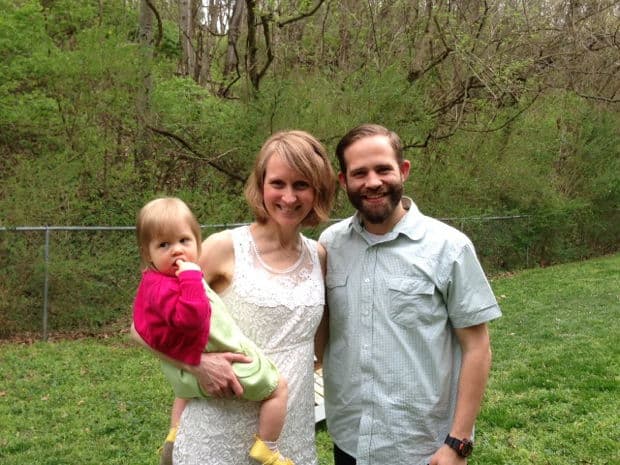
At InterVarsity's Graduate & Faculty Ministry Staff meetings in the spring, I met Colin Fagan, who described how he is the primary caretaker of his daughter. When I expressed interest in a potential interview, Colin suggested that I also meet Brian Pugh, who was at the meetings as well. I thought readers at The Well would enjoy hearing about their experiences. We set up an interview, and we share it here. — Marcia
Colin and his family.
Colin: I can't say that it was necessarily deliberate, that would make it sound like we were really, really intentional about it, and that's probably not true. Most of our conversations before making the decision gravitated around the idea that my wife and I wanted to be very present parents, but we were not really sure what that looked like. But we were open to possibilities.
My wife has a fantastic job and has really flourished in her workspace. When I came on staff with InterVarsity, we knew there was fundraising involved. When my wife got pregnant, we were thinking, okay, I'll be done with my fundraising and then she can look at transitioning, maybe be home and work part-time, or just be home for a while. We were both very open. But honestly, the fundraising just didn't go the way that we thought. So in light of that, we had our child and financially it just wasn't feasible for us to make a shift. I basically said, I will stay home with our daughter two days a week. Saying that, I realized that everything up until that point had just been mere conversation. But I saw that this was a really great opportunity for me to have a season of my life where I am a stay-at-home dad, and to see what that's like. So, one part at least was that I just had to own my words. And I am so glad that I've had to own those words.
But for the most part, it was more practical than that. Though I will say that my wife and I had real flexibility to explore what this might look like, that didn't necessarily have to be her staying home full-time and me working. We could both be working part-time, even with InterVarsity fully funded.
Colin: She is back full-time, yes.
So I work two jobs, along with being home. We have our child three days in daycare, and then I'm with her two days, technically four because it's also through the weekend. But luckily I can tag-team with my wife on the weekend. So, two days a week I'm with her and then three days, she's at daycare. And along with those responsibilities, there's also part-time InterVarsity work and I am part-time with a local parish in Nashville.
Brian: I don't think we ended up this way intentionally, either, but I knew even when we were dating, senior year of college, that she was going to medical school. Going into it I always knew this was going to be a very real possibility.
After about eleven years of my wife’s training, we had our daughter. And it just seemed right for me to cut back. The ministry was good, I was full-time, but I decided to cut back to part-time, half-time with our first daughter. And then two years later, we had our second daughter and I cut back to eight hours a week.
I'm not as career-driven as my wife, and never have been. I think as far as gifts, it’s worked. As far as just personalities, it's worked really well. I think she wishes she could be home more but at the same time, it would drive her crazy. But, like Colin and his wife, I think philosophically that's something we really valued, to be present parents. And so if one of us had to do it, I'm happy to do it. And she's happy for me to, so it works well.
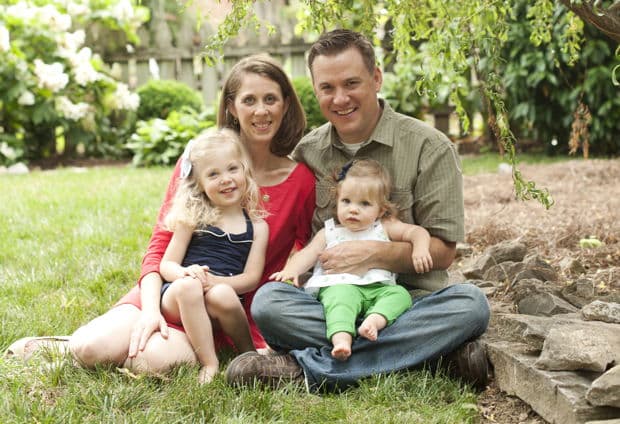
Brian and his family. (Photo: Brooke Kelly Photography)
Colin: The two words that come to mind for me are learning gentleness and humility. Our daughter has been having some special needs. They don't seem to be long-term, systemic issues, but they are hurdles that she has to face. My wife and I have to play an active role in helping her move through the gross-motor-development-related challenges that she has right now. So, I’m wearing multiple hats. I’ve got the dad hat and all that involves. But then at times I’m having to teach my daughter how to crawl, or how to walk, how to do these things, being more of a physical therapist, which is a really tough space to be in, trying to be both. My daughter seems to intuit this, "Something different is happening here, and I don't like it."
Learning how to manage all of the swells of emotion that come for me when trying to, for example, guide her through a certain exercise, and it's not happening, and just feeling like a complete failure as a father as well, is so hard. I think in those moments I’m having to learn a lot of humility and gentleness. And empathy would probably be a third. Now when I'm in public and see moms who are with their kids, and their kids are devolving right before everyone's eyes, I can understand. Maybe two, three years ago I would've been, "Can't they get it together?" Now I'm thinking, "Oh, I totally understand what that's like." So I find just my whole perception of what parents go through has taken a pretty significant turn.
Brian: For myself, it’s been very sanctifying. I see the worst of me come out some time after being home with them. I can get very frustrated.
Colin: [Laughing] Oh, man.
Brian: And tired, so it points to my sinfulness. I think discipline is warranted and I think discipline is good. But you know, it's discipline and frustration sometimes. I just see how fallen I am, and how impatient I am. And then you see — my wife and I were talking about this the other day — it's just such a picture of how God must see us, "I keep telling you to do the same thing over and over and you never do it. I keep reminding you and you never do it.”
Our daughter's having trouble listening. You can ask her a question and she doesn't even respond. Then you ask her again. She doesn't respond. Then finally it's like, "You need to answer me." "Yes." And you're like, okay, that's kind of how we are with God.
Brian: Yes, I would never abandon my child. But you know, I could see why he's frustrated with us, wants to discipline us.
Colin: We really try to collaborate. And I think in many ways, we've done that pretty well. My wife and I — I know it sounds completely cliché, but it's true — really try to approach our life as a team.
So there are times when Gretchen really takes the lead and spearheads. And then there are times where I do. And then there are times where we just straight collaborate on stuff. It just sort of all works together. So when I'm home I tend to find myself thinking a lot more about dinner and I will make dinner, even on the days where I've been working all day. I find myself thinking, "Okay, what are we doing for dinner?" And I try to be more proactive with that. Housecleaning tends to be a collaborative effort, a lot more happens jointly than separately. I think if we were trying to do these different things in compartmentalized ways, if life wasn't chaotic enough, it would just probably be that much worse.
Brian: I've always cooked for us.
Colin: Nice.
Brian: Ever since we’ve been dating, I've always been the cook. I think during med school we shared cleaning because I was working and she was at med school. But once she went to residency, I was in seminary and had more flexibility, so I took over cleaning and pretty much have done the cleaning since. We teamwork on decisions about preschool and handling those kind of things, because she wants to be involved as much as she can.
She, almost always, since she doesn't get to see them much, gets them up in the morning and lets me sleep a little more and then usually puts them to bed while I'm cleaning up dishes. I'll go up and say goodnight, but it's kind of her thing, which is hard because she comes home from a full day of work. It's dinner and then it's to bed. And that's often when they're at their worst.
So we just kind of have roles that we've fallen into, and share. It does seem that no one does laundry. [Laughter] No one's grabbed that role yet. My wife tends to take care of hers and our daughters’ and I just sort of focus on my own.
Brian: I'm glad we have girls. I prefer having girls. Well, and it's all I know. But I've always thought I wanted at least one girl. I'm happy with two, like I like being Daddy to the little girls and I think I would have less patience with little boys
Colin: I think for whatever reason it would be harder for me to be home with a boy all the time.
Colin: I don't know the full extent of it, but it has done some pretty heavy soul work in my life. Again, I don't know exactly what all of that entails, but there is something about parenting a daughter that does strike me as very different from what I see going on with friends who have boys. There is something different about it.
The image that I'll always carry with me is from when our daughter was born. She had seizures and ended up in the NICU. I had the very difficult experience of watching her have one and had two very competing yet visceral emotions. One was this overwhelming sense of, whoever's hurting you, I will absolutely beat them up. But then the other one is a deep sense of helplessness, because I have no way to help her. But that first deep sense of, I'm going to protect you by any means necessary, that has I think framed my experience of being a dad to a little girl. I don't know if I would necessarily have that same deep sense with a boy. I could be wrong, but that image certainly has framed it for me.
Brian: I don’t really feel that need for that. I do have a couple of friends with young kids who are doctors with flexible schedules. One of them is off on Wednesdays and the other is seven on, seven off, so I get to see them through the week, which is nice. And I'm glad my wife's there to talk to about it. And I'm glad I have work as an outlet to not be doing this one hundred per cent of the time. I would struggle with that.
Colin: I think I would echo what Brian just said. It probably is in large part because we have a lot of very close friends who have had kids. And I'm not with my daughter full-time, so there's enough space there that I can decompress pretty well.
Brian: I will get a little bored, but I'll just call somebody during the day, like while they're playing. I'll just talk to somebody for twenty minutes, just to, I don't know, talk to somebody.
Colin: Probably not. I know my wife wants to be home more and we are working to make that a reality. So, I imagine some of the caretaking duties will shift over time.
Brian: I do. My wife, as I said, is much more career driven than I am, plus she is much better at her career! She is extremely gifted as a physician and educator. I feel like I would be taking her away from her calling if I asked her to be primary care-giver. I do think that once school for the girls starts to pick up, I will add to my ministry hours, but until then I think this is the arrangement that works best for us.
Colin: I would say: do it. It is not without its layers of difficulty but it is worth it. I think I am becoming a better human by being home with my daughter and learning how to parent. There really are few contexts in life that God uses to truly bring about substantive change in one’s life, but being a stay-at-home parent is certainly one of them.
Brian: I say pray about it, seek instruction from those who are older and more experienced than you, and don’t be afraid to do it. As difficult as it can be some days, it is wonderful and it is something I highly value. I would hate to miss out on the opportunity because of some external pressures. I do know that it is not feasible for some people, and that is good too. There is not one right way, but this works great for us!
Tags:

Marcia Bosscher is the former editor of The Well and now an associate with InterVarsity's Faculty Ministry. Having been married to a professor and sharing life with grad students and faculty in a campus church, she has a deep interest and care for those in the academy. She lives in Madison, Wisconsin, with a golden-retriever mix and a diverse array of lodgers and travelers.