
Published 16 Aug 2012
God's Vast Love: An Astronomer's View
Professor Deborah Haarsma shares some of her favorite astronomy photos and considers what they reveal to her as a Christian.
By Deborah HaarsmaA blog post Women Scholars and Professionals
A passenger settles in beside me on the airplane. We chat a bit about our destinations, and then comes the inevitable question: “So, what do you do for a living?” I pause a moment before answering. If I answer “astronomy,” I know my fellow passenger will perk up, comment that he has always loved stars, and ask a question about a comet or planet that’s been in the news. If I answer “physics,” he will shrink back, comment that he didn’t do well in physics in high school, and the conversation will quickly come to an end. My professional colleagues have noticed the same thing. We joke that if you want to sleep on the plane, just answer “physics!”
It’s true that physics sounds scary to many people, and it can indeed be a difficult topic to learn. Yet I’ve always loved physics (my degrees are in physics rather than astronomy), because of the way that mathematical equations can describe and predict so much of what we see in the world around us. One reason I got into astrophysics is because the universe contains so many bizarre situations that we can’t reproduce on earth, like ultracold, or extremely high density, or extremely high magnetic fields. It’s a fun challenge to figure out which physical process will be the most important when the situation is so dissimilar to everyday experience. But if the word “physics” makes you shrink in distaste or fear, don’t worry. For the rest of this article, we’ll focus on a more friendly topic: astronomy.
In the last decade or two, our knowledge of the universe has grown dramatically as many new telescopes and spacecraft have come online. In this essay, I’ve selected some of my favorite recent astronomy photographs to share with you. As a professional astronomer and a Christian, I feel God has called me to share these wonders with the church. Many times, these new discoveries are presented without any mention of God, and sometimes in a context of overt atheism. I want to share these things with you in a Christian context, with God as their creator.
The Milky Way
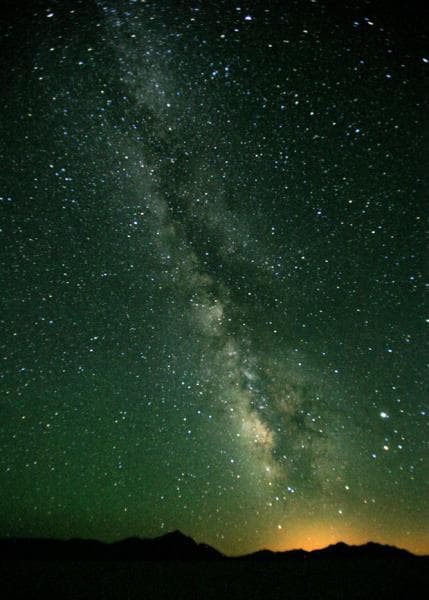
Have you ever seen the Milky Way? If you live in a rural area, you may have seen it many times. If not, it may have been a dramatic surprise when you first saw it while camping or traveling. On a clear night out in the country, the sky is strewn with brilliant stars — many more stars than you can see under city lights. The faintest stars form a creamy, smoky band from horizon to horizon. Our galaxy contains billions of stars, and thousands of those stars are visible to the naked eye. The stars appear in a band across the sky because we are viewing on galaxy edge-on, like looking at the edge of a dinner plate.
The Milky Way.(Image credit: Wikipedia Commons, Steve Jurvetson.)
The heavens declare the glory of God; the skies proclaim the work of his hands.Day after day they pour forth speech; night after night they reveal knowledge.They have no speech, they use no words; no sound is heard from them.Yet their voice goes out into all the earth, their words to the ends of the world.
The heavens are displaying the glory of God for all people to hear, proclaiming their message to people of every language, tribe, and nation. Just about anyone who looks up at the night sky feels a sense of wonder. Yet as Christians, we feel more than a vague sense of awe; we know the Creator of the heavens personally, as our own loving Father.
The heavens declare more than God’s glory. The universe is God’s revelation of himself to us, and teaches us about his character. As the Belgic Confession says about “The Means by Which We Know God,”
We know him by two means:
First, by the creation, preservation, and government of the universe, since that universe is before our eyes like a beautiful book in which all creatures, great and small, are as letters to make us ponder the invisible things of God: his eternal power and his divinity, as the apostle Paul says in Romans 1:20.
Second, he makes himself known to us more openly by his holy and divine Word, as much as we need in this life, for his glory and for the salvation of his own.
The natural world teaches us about God’s glory, power, divinity, faithfulness, extravagance, immensity, love, and other attributes. God’s special revelation in Scripture is our primary place to learn of God’s character, but the natural world can bring the message to our senses in a powerful way beyond mere words on a page. The Holy Spirit can use the natural world to get the message past our hardened or weary hearts. Nature illustrates these attributes in ways that enlarge our imaginations to appreciate afresh the glory of God.
The Sun
The Solar Dynamics Observatory was launched into space in 2010, the latest of several spacecraft to photograph the sun in detail. The photo below shows the face of the sun with a sprinkling of sunspots. The sun is powered by nuclear fusion reactions deep in its core which heat the hydrogen and helium gas till it glows. A sunspot is a place on the sun’s surface where the gasses are a bit cooler than the surrounding area, so that it glows less brightly and appears dark.
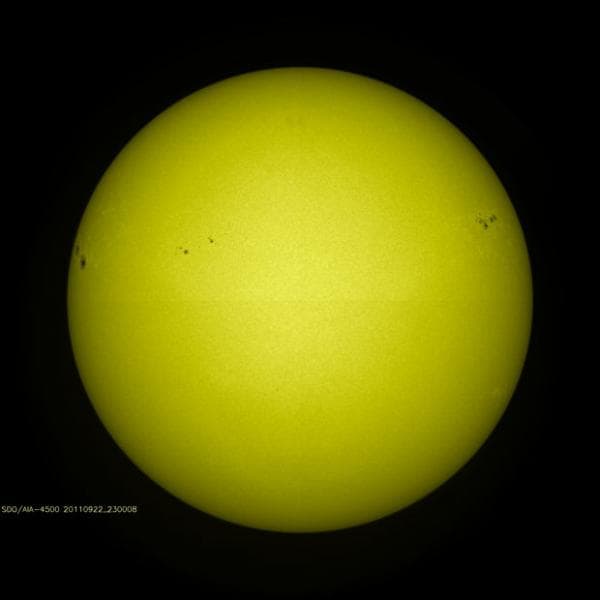
The Sun on September 22, 2011, in visible light as seen by the Solar Dynamics Observatory.(Image credit: NASA, Solar Dynamics Observatory.)
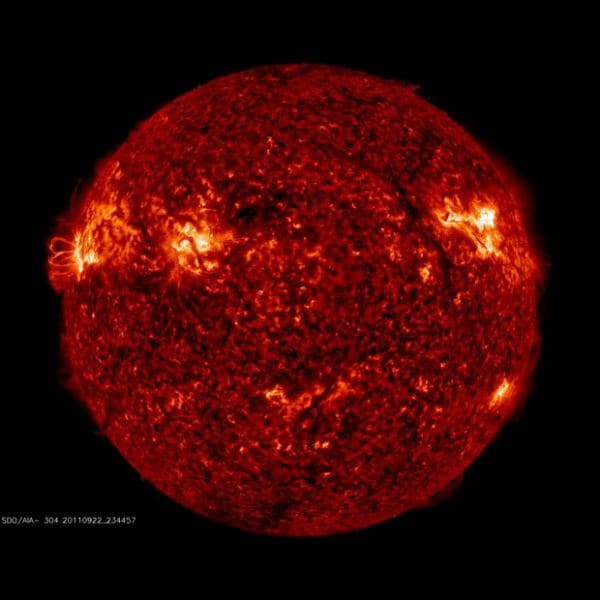
The Sun on September 22, 2011, in X-ray light as seen by the Solar Dynamics Observatory.(Image credit: NASA, Solar Dynamics Observatory.)
Because of modern spacecraft, telescopes, and cameras, we can see so much more in the heavens than what is visible to the naked eye. Thus, we are seeing more of what the heavens have to declare about God. In Psalm 19, David goes on to describe the sun:
In the heavens God has pitched a tent for the sun.It is like a bridegroom coming out of his chamber, like a champion rejoicing to run his course.It rises at one end of the heavens and makes its circuit to the other; nothing is deprived of its warmth.
If David had lived today, maybe he would have written about other properties of the sun, like the power of God as seen in nuclear reactions and looping magnetic fields. As it is, he makes two important points. One is the universal warmth of the sun, by which God provides for all life on earth. The other is the faithful path of the sun, day after day, unchanging year after year. In the book of Jeremiah, God promises his people that he will not break his covenant with them, any more than he would break his covenant with day and night and the fixed laws of heaven and earth. The sun is a persistent reminder, woven into our lives, of God’s faithfulness to his promises.
Asteroids
In July 2011, the spacecraft Dawn arrived at the asteroid Vesta. Vesta is about 530 kilometers across, or about the size of Wyoming. This beautiful image shows the varied texture on Vesta’s surface. Vesta has craters like the moon, but also ridged bands along the upper left. In fact, there are craters on top of the ridged bands! Just from looking at the surface, it is clear that Vesta has a history, in which the bands formed first, and after that small asteroids hit Vesta to make the craters on top of the bands.
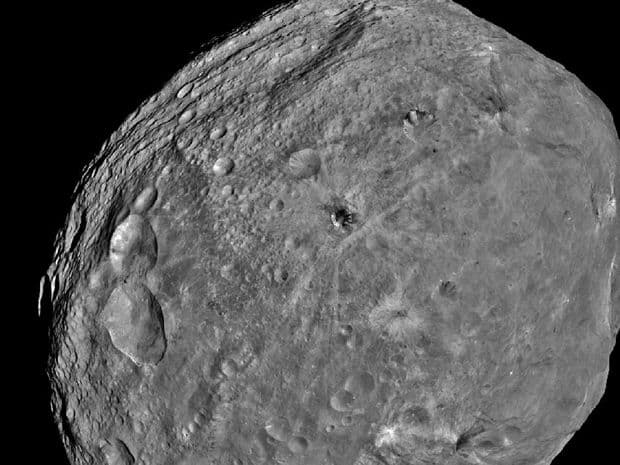
Asteroid Vesta as seen by the Dawn spacecraft.(Image credit: NASA/JPL-CalTech/UCLA/MPS/DLR/IDA)
Charting the origins of asteroids is an excellent example of historical science: by using the evidence we see today, we can deduce what must have happened in the past. Very few assumptions go into the orbit calculation, just Newton’s laws of mechanics and gravity. Even though no one was there to see the collision, the orbits today show that a collision occurred millions of years ago. God gives us a glimpse of how he created the asteroid belt.
The idea that something happened millions of years ago may seem startling to you. Christians disagree about the age of the earth, solar system, and universe. Some Christians believe the solar system is only ten thousand years old, in agreement with the genealogies recorded in the Bible. Other Christians believe the solar system is 4.6 billion years old, in agreement with many lines of evidence from astronomy and geology, including asteroid collisions.
Since God has revealed himself in both Scripture and nature, we need to take both revelations seriously. Both revelations require human interpretation: scientists interpret the evidence in the natural world, and Christians interpret the Bible every time they read it. Many biblical scholars say that the best interpretation of Genesis indicates that it was never intended to teach scientific information about the age of the universe, but it was intended to teach truths about God’s sovereignty and the goodness of creation.
Nebulae
When you look at the night sky, the space between the stars looks black. This image, however, shows that the space between the stars is actually filled with rich complexes of dust and gas. The Carina Nebula is located 7,500 light-years away. A light-year is the distance that light travels in one year, so that means the light we see left the nebula 7,500 years ago. This image is about thirty light years across. The beautiful colors represent different types of gas: blue for nitrogen, green for hydrogen, and red for sulfur. The dark clumps and filaments are regions where dust clouds absorb the light.
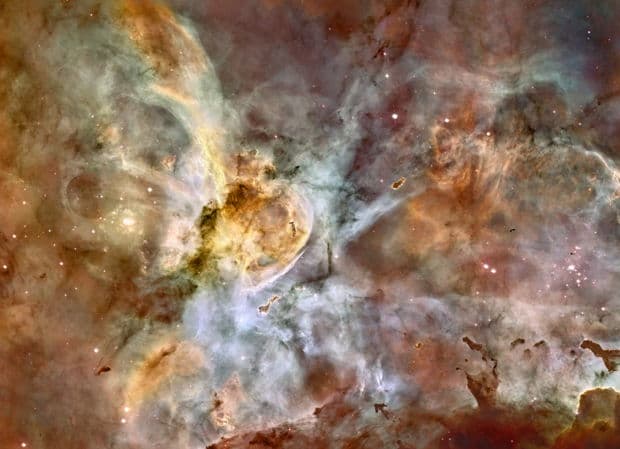
Carina Nebula as seen by the Hubble Space Telescope..(Image Credit: NASA, ESA, N. Smith (University of California, Berkeley), and the Hubble Heritage Team (STSCI/AURA))
The resulting picture is as elegant as an abstract painting, truly a display of God’s artistic creativity. This nebula was around long before human history, but only in the last decade or two have we had telescopes and cameras to make images like this. We’ve found nebulae throughout our own galaxy and in other galaxies; God appears to have filled the universe with an extravagance of beauty, even where no human is there to see it.
This nebula displays God’s creative nature in another way: in this region God is creating new stars. It is an active “stellar nursery.” The smallest dark globules in the lower center of the picture are similar in size to our own solar system. Each globule will likely become a star with planets of its own. Our own solar system probably had its origin in a nebula like this. God brought together the dust and gasses in a swirling cloud to make the sun, earth, and planets. The very nitrogen in our bodies was once glowing in a beautiful nebula. God made us from stardust.
This nebula illustrates an important truth: a scientific explanation does not replace God. Some atheists say, “Scientists can explain this, so there’s no need for God.” And some Christians say, “Scientists can’t explain this, so God must have made it.” Both statements make the error of assuming that a scientific explanation is somehow a substitute for God. Yet in other areas — gravity or photosynthesis or chemical reactions — we view God as upholding the laws of nature. We don’t say that natural laws indicate God’s absence. For a Christian, a scientific explanation doesn’t diminish God’s role; it gives additional insight into God’s action and increases our praise of him.
Galaxy Clusters
Since the Chandra X-ray Observatory was launched into orbit in July 1999, it has been sending back amazing pictures of the universe in X-rays. As with the sun, this galaxy cluster looks very different in visible light and X-ray light. Below is a visible light image from the Hubble Space Telescope of galaxy cluster Abell 1689, located 2.3 billion light years away. You can see hundreds of yellow galaxies, each containing billions of stars. Many of these galaxies are larger than our own Milky Way galaxy.
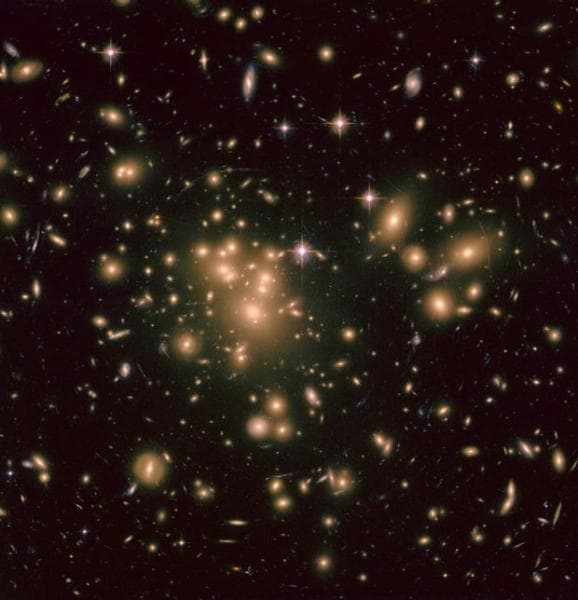
Galaxy Cluster Abell 1689, in visible light from the Hubble Space Telescope.(Image Credit: NASA, ESA, E. Jullo (Jet Propulsion Laboratory), P. Natarajan (Yale University), AND J.P. Kneib (Laboratoire d’Astrophysique de Marseille, CNRS, France).)
Before X-ray telescopes, astronomers had no idea that there was more to a galaxy cluster — we thought the space between the galaxies was basically empty. Below is an image from the Chandra X-ray Observatory of the same region of space. Instead of individual galaxies, the image shows X-rays coming mostly from a huge cloud of hot gas filling the space between the galaxies. In fact, there is much more mass in the gas than in the galaxies!

Deborah Haarsma is chair of the Physics & Astronomy Department at Calvin College in Grand Rapids, Michigan, where she enjoys researching galaxies and galaxy clusters with her students. She speaks and writes on science and Christianity, including Origins: Christian Perspectives on Creation, Evolution, and Intelligent Design written with her husband Loren, and Delight in Creation: Scientists Share Their Work with the Church, an essay collection edited with Rev. Scott Hoezee. When not at work, she can be found tending her rose garden or reading Lois McMaster Bujold novels.