
Published 13 Dec 2012
Holly Ordway: Literary Apologist
Holly describes the role of literature in her coming to faith and the connection between her development as a teacher and her discipleship as a Christian.
By Holly OrdwayA blog post Women Scholars and Professionals
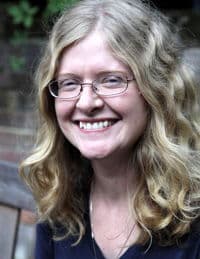
Holly Ordway spoke in Madison, WI, at a conference on the ten books that most influenced C.S. Lewis; speaking on Charles Williams' Descent into Hell. During that time, she spent a morning with the grad women's group and talked about her conversion, mentoring, and teaching. This interview was conducted after that visit.
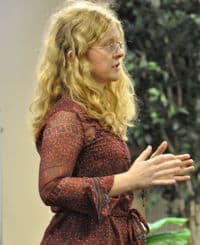
Yeah, I love teaching. I’ve been teaching for a long time. I taught as a graduate student, and then I taught for seven years at a community college in California. Now I’m at Houston Baptist University. And I think the thing that surprised me when I became full-time faculty, which I’m used to now, is how much work there is to do that’s not what people think of as “teaching.” There’s all the administrative work that even regular faculty members have to do — paperwork, committee meetings, recording grades, and so on. And even for teaching, what you see in the classroom is just the tip of the iceberg as far as preparation goes. In the class, having a discussion, it may look like I’m coming in and talking to my students, but there’s a tremendous amount underneath of prep work, of reading, of knowing about the particulars of the students that I have, what do they need, what do they understand, and where are the gaps, and what do I want them to get out of this — it’s amazing how much more you need to know of the material than you think you do.
There really is a lot that has to happen conceptually outside the classroom, and then when that’s done, then the classroom experience seems very easy. When I was a new teacher, I used to have these detailed lesson plans down to five or ten minute increments of what we would do for activities, and that was helpful at the time. It covered what I would do if we ran out of things to do. That used to be a problem — now the problem is always that we don’t have time for all the things I want to do.
But one of the things that I came to understand wasn’t something I had learned as a graduate student but something I learned as a full-time faculty. You need to be able to think on the fly. It’s an organic situation that includes my students, their preparation, their state of mind on that given day, what I know, where I want them to go... so there’s going to be decision-making processes that happen within the classroom that you can’t possibly prep for. You can only respond as you go. Sometimes the best decision is to scrap everything you’ve planned and do something totally different — but that decision has to be based on experience of recognizing when something isn’t working, and understanding why, and having a number of different alternatives in your head, so you can smoothly transition over to something else. Teaching is creative work in real time.
I taught a year as a high school teacher in between when I finished my graduate work and before I went back to college teaching. I was a complete failure as a high school teacher. One of the reasons I was a failure was that I wasn’t actually particularly competent. I was teaching Spanish and French, not teaching in my field. Now if I had just recognized that, I probably would have done okay, but instead I was trying to fake it. I want to add, many people, at some point, are distressed by the feeling that they’re faking it, but in fact they’re not; they’re just nervous, which isn’t itself a bad thing. Just because you feel like an impostor doesn’t mean that you actually are.
Actually men will sometimes say it too. When I’ve felt like an impostor, I just had to recognize, I may feel like I’m not qualified, but evidently the people who hired me think I am. My feelings are irrelevant. I just need to do my job.
That said, there are times that I can recognize that my skill set doesn’t match the needs of my position. That was the case in my high school teaching. At that point, the right response would have been not to just bluster through it; the right response would have been to admit that I was having trouble and seek some more help. I didn’t — this was before I was a Christian, and I didn’t have any idea how to deal with the real issues, which were spiritual — pride, humility, patience, insecurity. My failure and insecurity in the classroom was part of what eventually convicted me of my own fallen nature: I could envision what kind of teacher these kids needed, and I was totally unable to be that person.
When I became a Christian I realized precisely that the problem was not my lesson plan; the problem was my character. And so a lot of my development as a teacher has been connected to my discipleship as a Christian. Repenting for when I was impatient, for when I was angry, for when I was frustrated, recognizing my own failings, and learning to follow Christ has formed the basis for growing as a teacher, and, really, as an academic and a writer too. And it has actually translated into a deep confidence in my vocation as a teacher. I can say to myself, hey, God has called me to be where I am, so I’m going to be there. I can have confidence that wherever I am, I can offer my teaching to my students, and we’ll go from there. I think that sense of confidence that I have in my work doesn’t come from any one moment or insight, but rather from the day in, day out work of teaching. That involves seeing the results over many different groups of students, and understanding my own limits, and allowing room for God’s grace to operate in my students’ lives and in my life.
Tags:
Holly Ordway is a poet, academic, and Christian apologist on the faculty of Houston Baptist University, where she is Chair of the Department of Apologetics. She is the author of Not God’s Type: A Rational Academic Finds a Radical Faith and blogs on literature, culture, and apologetics. She was a competitive sabre fencer for nearly twenty years and considers a really good cup of coffee to be one of life’s simple pleasures.