
Published 2 Sep 2026
Notes from a Physicist Grandmother, Part 2: Being Brave and Being Patient
By Catherine Hirshfeld CrouchA blog post Women Scholars and Professionals

What values need to be centered when navigating the waters of career and family life? Professor Catherine Crouch shares guiding principles in this second in a series of four articles.
In the many conversations I’ve had about combining work and family, I’m frequently asked a question that is obvious, yet nonetheless takes me by surprise: “How were you so sure about raising a family that you could take such risks with your career?” The first time someone asked me that, I couldn’t think of how to answer. For as long as I can remember, long before I met Andy and knew that I might have the opportunity to be a mother, I had been utterly sure that being part of children’s day-to-day growing up was joyful, important, and worth risk and sacrifice. But to do so takes courage and patience. So how do we gain the courage and the patience to do so, as well as the necessary wisdom? In this essay, I’ve tried to step back and identify the principles and practices that guided my choices and actions.
Know your priorities
I believe that being brave and patient begins with knowing your priorities. What are the most important things for your life to include? Some of your priorities may relate to what the professional world sees as your gifts, but the Christian faith affirms that people are also worth prioritizing. Whether married or single, all of us are part of families and neighborhoods, and many of us are part of churches; these communities, along with our workplaces, offer the opportunity to give of ourselves sacrificially.
When I finished my PhD, my priorities included both raising children and being a scholar deeply engaged with teaching college students. There was no question for me that if I had to choose between the two, I would choose to raise children. But rather than assuming I was forced to choose, I sought a creative way to pursue both wholeheartedly.
Think creatively
Being brave, in this context, means don’t just do what people say you are supposed to do. When I was finishing my PhD, I didn’t know anyone who had worked part-time while a postdoc or had even taken maternity leave. However, I knew many women with young children who worked part-time, and I knew older women scientists who had raised children while working full-time. So, although I didn’t know anyone who had done this, it seemed like a logical approach to the challenge of combining work and family.
Such out-of-the-box thinking is unfortunately rare in both academic communities and churches. The conventional wisdom in academia is to put your life on hold until tenure (and maybe longer) and to go wherever the best job is. Sadly, it is the unusual church in America that encourages women to consider integrating professional work with family life, especially work that isn’t often considered ministry, such as a college or university faculty position.
Be realistic about your abilities and goals
Succeeding while making unconventional choices required being very realistic about my own abilities, accomplishments, and professional goals. Based on my work so far, what future professional accomplishments were reasonable for me to anticipate? What professional circumstances were needed for me to continue doing excellent work while working part-time? What scientific problems could I work at successfully at a part-time pace, and who might I work with? What kind of position did I ultimately want, and how would that position be congruent with my desires for family and community life? Although caring for children during the newborn to preschool years is particularly intense, the demands of family don’t end when children start school. Arguably, these years are even more fun, so I didn’t want to miss out!
Don’t rush; do good work and honor your colleagues
That realism must coexist with being committed to excellence and collegiality, while distinguishing excellence from speed. Professional colleagues wanted to work with me, in spite of my limited availability, because they knew they could count on the quality of my work, they trusted me to do my part and honor theirs, and they enjoyed working with me. Although academia, particularly the sciences, prizes being the first to stake out territory, deep insight typically doesn’t accompany hurry. And doing excellent work takes time, no matter how much focus and efficiency you can achieve. I learned from a wise mentor that even if someone else “gets there first,” an overlapping (not identical) later contribution, if wisely designed and carefully done, almost always adds to the community’s understanding, and so can be published. And as Christians, I believe that we are called to resist the academic tendency to view other scholars in our field primarily as competitors, and scholarship as an arena in which to establish our own reputation rather than to contribute to the community’s knowledge.
Fundamentally, I think we must take a loving posture toward our work, as well as to our colleagues, in order to resist those pressures. In the next essay, I will explain what I mean by doing our work lovingly, and share some concrete practices that support this posture.
Be willing to take risks and close off options
Bravery means being willing to make choices that close off options, might not turn out perfectly, and might even go badly. Academics specialize in exploring every possible detail and crafting a tight argument around a very narrow question, so, understandably, those of us who are good at that often find it difficult to accept the risks and unknowns that come with most of life. But we are called to live trusting in God, not in our ability to plan everything perfectly. In fact, neither a life devoted to loving God and neighbor, nor a truly creative life of scholarship and student-centered teaching, allow the level of control we may wish for.
For my postdoc to be a good opportunity to both continue my training and start our family in the way I wanted, I needed to find an advisor who would be supportive of part-time work and with whom part-time work could be fruitful. We also decided we wouldn’t move: we wanted to stay connected to our community and to allow Andy to continue in his work. Prioritizing a part-time postdoc in the Boston area eliminated a lot of possibilities: I could think of exactly one possible advisor whose research group had the promise of offering these things. Providentially, he was also excited about my joining his group and supportive of my intended trajectory. Sometimes one possibility is enough.
As I made scholarly decisions during my postdoc, I could have benefited from being more willing to bring projects to an end, and to periodically step back to reflect: which parts were bearing the most fruit? What was limiting those that were less fruitful? My tendency, once a project was begun, was simply to persist; I didn’t realize until much later that developing the skill of assessing why a project is or is not progressing, what might be holding it back, and whether it should be continued or abandoned, is essential in becoming an independent scholar.
Be willing to make sacrifices
My postdoc wasn’t perfect. The usual challenges of research were amplified by working at a slower pace. The project I had planned to work on ran out of funding, and I had to pivot to a different problem entirely, leading to a more difficult transition when it came time to establish my own research program at Swarthmore. Even with these limitations, this position provided a way for me to pursue my calling.
During my postdoc, Andy worked first as a campus minister and then as the editor of a startup Christian magazine. We would have needed to live simply to stay within our combined income as a couple, but to do so with children required being very frugal. We had several privileges that made this easier: we didn’t have any student loans, and we had the safety net of savings and parents we knew could back us up financially in a pinch. But this didn’t change the sacrifices, such as cooking nearly all of our meals and eating out only a few times a year. Nonetheless, sacrifices can make others’ gifts to us all the more precious: several friends either took care of our kids for free or paid for babysitting so that we could have occasional nights out and participate with less distraction in our small group.
When our daughter was only a year old, I was recruited for a tenure-track position at the college I had attended. Although there would have been many wonderful things about teaching there, I wasn’t ready to return to full-time work with a one-year-old, and it was not near any of our current community, longtime friends, or family. So I didn’t apply.
I’ve mentioned other sacrifices elsewhere in these essays, both professional and personal. As I’ll describe in the next section, now that I’m fifty-seven, I’ve also experienced that God has restored many of those things. I want to encourage you to be watching for those restorations, and to remember that it may take a long time.
Remember you don’t have to do everything at once
I believe it’s essential to take the long view if you are a parent, especially a mother, who wants both family and work to be part of your vocation. Although not everyone will choose to work part-time for a season, anyone who prioritizes being available for children will have to slow down, or put other pursuits on hold in some way.
During my postdoc and for the first ten years of my faculty position, I said “not now” to anything that wasn’t essential, such as leadership in national professional organizations, serving on advisory boards or national policy committees, outreach, and public-facing activities. Most of all, I minimized travel (which a liberal arts college job allows more readily than an R1 university position). During the latter part of my postdoc, after my daughter was born, and for the first few years of my faculty job, I attended only one conference per year and gave only a handful of invited talks out of town. Some of these opportunities were more painful to decline than others, and I often worried that I was failing to achieve important milestones. But looking back now, I can say that although there were certainly costs to devoting time to family, they were not what I feared. I relinquished status and recognition for a time, and I haven’t achieved everything that some of my peers have. Nonetheless, in God’s providence, all of the truly worthwhile opportunities did eventually return. I have done good work and am honored for it by the people in my professional community whose judgment I value most. The greatest cost of my slower pace was my own worrying.
Do not expect to see the whole path at any one time
It may seem like there is a particular academic career path that must be followed. Actually, there is huge variation in how people become scholars, and tremendous unpredictability in circumstances and opportunities. I mentioned above how funding came to an end for one of my intended postdoc projects, and I had to pivot. As part of the outside speaker series we offer for students in my department at Swarthmore, we ask our speakers to spend a few minutes at the start of the talk describing their career trajectory. The great majority of our speakers describe their paths as including unexpected twists and turns, or say that although they are happy where they are, they didn’t expect to end up there. And finally,
Develop practices for keeping your life whole and integrated
especially practices that attend to all the dimensions of your calling. Ultimately, being brave and patient comes from trusting that you can be creative and take risks, but you don’t need to hurry or grasp at opportunities. If we trust that God is at work even in our current circumstances to provide and to redeem, and that in the new heaven and earth, all things will be made right, that is the best possible foundation for patience. The same practices that help you hold lightly your discerned vocation will also help you cultivate this trust, allowing you to be patient with the slow work of God.
In the remaining essays in this series, I will answer some of the most common questions I hear about how to become and sustain being the kind of people who can be brave and patient, providing suggestions of practices that support living out of these principles.
For more from Catherine Crouch, read the first article of this series.
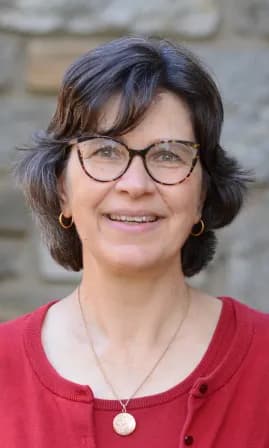
Catherine Hirshfeld Crouch is Professor of Physics and Department Chair at Swarthmore College, where she has taught since 2003. Trained as an experimental condensed matter physicist, she is an expert in pedagogical best practices for undergraduate physics education; her work on physics for life science and pre-medical students has received national attention and support from the National Science Foundation. In 2021, she was elected a Fellow of the American Physical Society for work spanning physics education research, curriculum development, pedagogy, and institutional leadership. She co-founded Swarthmore’s STEM Inclusive Excellence initiatives to expand support and resources for underrepresented and first-generation students in the sciences. She is a mentor to early-career Christians in academia through the Veritas Scholars program, and serves on the Board of the John and Vera Mae Perkins Foundation. Crouch earned her PhD. at Harvard University and worked with Eric Mazur as a postdoctoral fellow. She is married to Andy Crouch and together they are the parents of Timothy and Amy, parents-in-law of Sophia, and grandparents of Miriam.
Catherine Hirshfeld Crouch is Associate Professor of Physics at Swarthmore College, where she has taught since 2003 and was awarded tenure in 2009. Dr. Crouch has extensive expertise in both the optical properties of nanoscale materials and pedagogical best practices for college and university science. She earned her PhD. at Harvard University and continued at Harvard as a postdoctoral fellow with Eric Mazur until beginning her position at Swarthmore. She has published more than thirty peer-reviewed research articles and regularly involves Swarthmore undergraduate students in her work. She has also spoken and written about the intersection of faith and science in a number of settings including the Q conference and InterVarsity’s Following Christ conference for graduate and professional students. She is married to Andy Crouch and together they are raising their children Timothy and Amy.