
Published 16 Oct 2025
Rebecca Sue: An Excerpt
by Kathleen Norris
A blog post Women Scholars and Professionals

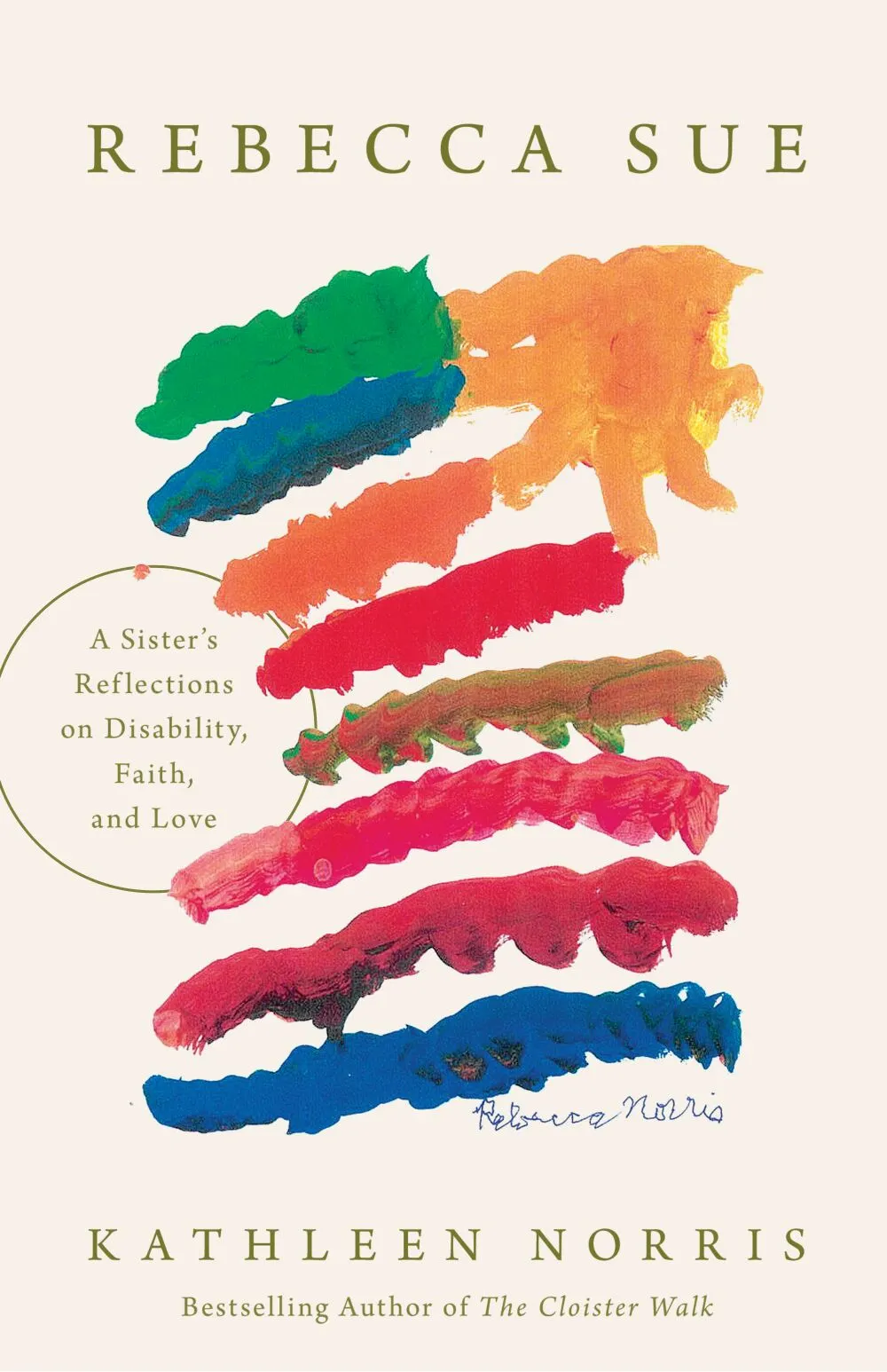
Dip into this excerpt from Kathleen Norris’s recent book Rebecca Sue: A Sister’s Reflections on Disability, Faith, and Love to get a sneak peak of the book behind Nicole Schrag’s review. This section is excerpted from the first essay in Part One.
The Rough-and-Tumble of Family Life
I could say that I grew up in a family with a special-needs child; but that doesn’t begin to tell the story. Becky was simply one of us. In 1952, when I was five and my brother was nine, our mother went to the hospital to deliver a baby and came home with our sister Rebecca Sue. All the talk about a new baby and my becoming a big sister had excited me, but I was disappointed at my first sight of Becky. She cried a lot and had a wrinkly face, as red as an apple. I didn’t understand why the grownups cooed over her, praising her dark eyes and abundant head of hair.
It was years before I heard the dire stories about Becky’s birth at Bethesda Naval Hospital: how my mother had been in labor for nearly forty hours, and this being the early 1950s, the nurses had been instructed not to let the baby come until a doctor was present. My mother had been overdosed with drugs that made it more difficult for her to push when required. She knew that things were not right; she’d been through labor before, with my brother and me. During the ordeal she heard one doctor say to another, “You got yourself into this mess; let’s see you get yourself out.”
Mom often expressed concern over how slow Becky was to grab for things, vocalize, and walk. Becky never did learn to crawl, but she developed an impressive ability to scoot like a little rocket around the house, clinging to a bit of blue blanket that she called her “mine.” This became a model for how Becky responded to obstacles. When she couldn’t do things “the right way,” she invented a way that suited her. We had this in common. When I took a required typing class in high school, I struggled to follow the rules and afterward developed a typing style that is mine alone.
My parents suspected that damage had been done during my sister’s birth, but doctors were not forthcoming with a diagnosis. When Becky was four they advised my parents to put her in an institution. Mom and Dad discussed this with me and my brother, John, and we all agreed that it was unthinkable to let Becky go; she was part of our family.
As a child I didn’t think of my family as different from any other. We kids had our squabbles in the rough-and-tumble of family life, and Becky was just a part of that. She was game to join us and the neighborhood children in playing hide-and-seek or running from imaginary elephants or wild horses.
The family had left Washington, DC, when my father, who had been an assistant conductor and orchestrator for the US Navy Band, was assigned to lead the band at the Great Lakes Naval Training Center outside Chicago. In the early 1950s we were living in a house in Beach Park, between Waukegan and Zion, one of several new homes in a nascent suburb; across the street a farmer tended a large cornfield.
There was a small slope in the front yard and during our first winter, John figured that with enough snow you could get a decent sled ride. One day he and Becky tried their luck. Becky was excited about sledding with her big brother, and I was content to cheer them on. We sometimes failed to grasp that Becky had difficulty understanding practical realities, like the importance of having the sled go straight down the hill and not sideways.
The sled was heavy. It had been our mother’s when she was a child, and we had brought it from her hometown in South Dakota the summer before. Becky’s skinny little arm got stuck in the wrong place and she yelled, sounding more surprised than in pain. John and I knew Becky was injured, but she wanted to try another ride. When we finally got her into the house and Mom got Becky’s jacket off, one arm was hanging at an odd angle. Clearly, there was a broken bone, but all Becky said was, “Mommy; my arm hurts.”
Becky was more accident prone than the rest of us. Once when we were visiting our grandparents in South Dakota, John, Becky, and I were taking turns riding a neighbor’s old, gentle horse. While Becky was riding, the horse suddenly knelt and rolled over her. You don’t realize how enormous a horse is until you see your little sister disappear underneath it. When the horse rose again, Becky stood up on her own and walked toward us. Our grandfather, a physician, examined her on the spot. She wasn’t hurt or even upset.
Our mother didn’t know what to make of two daughters who were notably awkward. She enrolled me in an excruciating “tumbling class,” where I consistently failed to execute somersaults and simple dance routines. With Becky, she didn’t even try, except that she insisted that all her children take swimming lessons at the local YMCA. Her biggest concern about Becky was her lack of common sense, and Becky did give us scares from time to time. Our house had a basement that Becky was not allowed to enter unless someone accompanied her on the stairs. The steps came straight down from the kitchen, but near the end you had to take a sharp turn just right, or risk falling onto the concrete floor. I enjoyed playing with my toys in the basement but found the stairs frightening, and descended them with caution.
Once when Becky was given permission to go downstairs to play with John, she became so excited that she took the stairs too fast and began to tumble. Mom had been following her but was unable to get hold of her in the narrow stairwell. John caught Becky in his arms. He says it was fairly easy, as she was a bean pole in those days, but he marvels that she was so eager to play that she was nonchalant about the danger she’d been in.
I have a similar memory. When my elementary school band marched in a parade at a Chicago-area amusement park, we were rewarded with passes for free rides. As Becky and I explored the park, we bypassed the roller coaster, as we’d learned that it would make us sick. But a ride on two-seater boats with large rubber bumpers looked promising. You steered the boat around a pool and deliberately crashed into the other boats.
I sat in front and steered and Becky sat in back, laughing happily until she apparently decided that she wanted to stop. If she said anything, I didn’t hear it over the noise of the boat motors and people shouting. It was a change in that sound—people screaming, sounding panicked—that alerted me: Becky had stood up and was in danger of falling into the water. People stopped their boats until I got Becky to sit down. As I drove our boat to the exit, Becky began to cry. I tried to reassure her that everything would be okay; I can still see that dark, greasy water.
The family’s biggest change came in 1954, when my mother became pregnant. My parents believed that Becky’s disability had been the result of medical error but were concerned this new baby might also be “slow.” They needn’t have worried. When Charlotte arrived in early 1955, she was so robust the obstetrician commented that she might as well walk home. She proved to be mentally and physically agile, early to crawl, walk, and form words. She also developed a forceful personality and could outdo any of us in stubbornness.
Mom felt that Becky was fortunate to have a sister just three years younger because in attempting to keep up with her, Becky developed skills she might otherwise have lacked. She learned to play jacks, for example, which I never mastered. And Charlotte’s facility with speech challenged Becky to up her game. The most important thing Charlotte did was to tell Becky no. Being so close in age to Becky was hard on her, and she learned early on to protect herself. She was quicker than the rest of us to refuse to indulge Becky because of her disability.
I was five years older than Becky, eight years older than Charlotte, and that was enough for me to often regard them both as nuisances. If I held myself as above their more childish pursuits, like playing with Barbie dolls, it didn’t mean that I loved them any less. I just became a little less likely to show it. As we all matured, both of my sisters provided me with plenty of surprises, becoming people I not only loved but came to admire.
Taken from Rebecca Sue by Kathleen Norris. ©2025 by Kathleen Norris. Used by permission of InterVarsity Press. www.ivpress.com.

Kathleen Norris is the award-winning poet, writer, and author of the New York Times bestselling books The Cloister Walk, Acedia & Me: A Marriage, Monks, and a Writer’s Life, Dakota: A Spiritual Geography, Amazing Grace: A Vocabulary of Faith, The Virgin of Bennington, and several volumes of poetry. Exploring the spiritual life, her work is at once intimate and historical, rich in poetry and meditations, brimming with exasperation and reverence, deeply grounded in both nature and spirit, sometimes funny, and often provocative.
Photo by Anna Kolosyuk on Unsplash